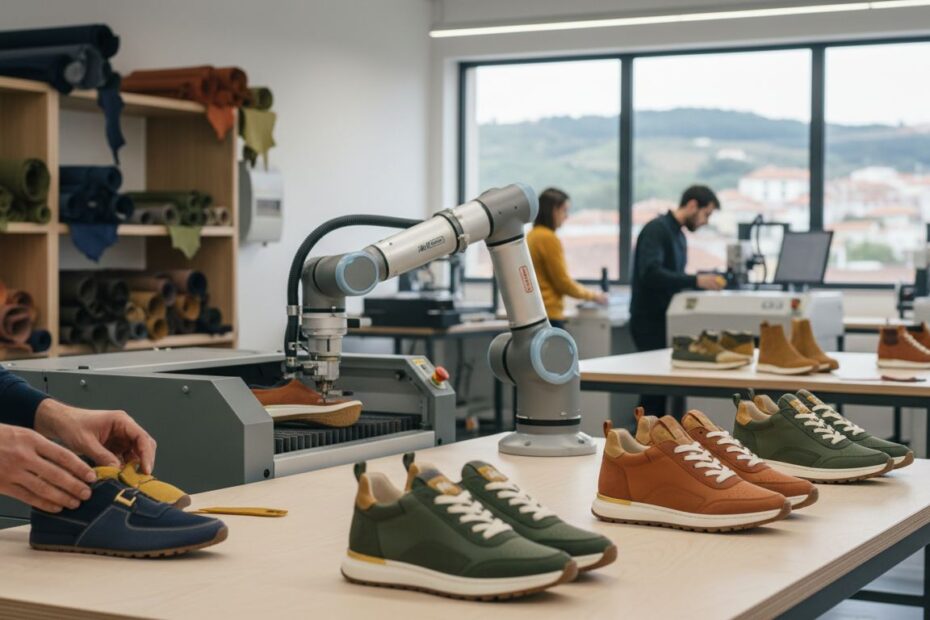
For emerging footwear brands, launching a collection no longer has to depend on committing to large inventory volumes, long lead times, or distant supply chains. Small-batch production is increasingly becoming a practical manufacturing model rather than a niche startup concept. A 2026 footwear manufacturing trend report described the normalization of small batch production as one of the most significant industry shifts, supported by rising global searches for low-MOQ and startup-friendly suppliers.
At the same time, nearshoring and selective automation are changing how these smaller runs can be produced profitably. For brands looking for a low MOQ shoe manufacturer in Portugal, this matters because it connects product development, shorter logistics routes, technical support, and more controlled production economics. Instead of choosing between flexibility and professionalism, younger brands can increasingly access both.
Why small-batch footwear is gaining real traction
Small-batch footwear has moved beyond the early-stage brand experiment. It is now part of a wider sourcing shift in which entrepreneurs, private-label buyers, and niche fashion companies want to validate products with less capital exposure. Rather than producing thousands of pairs upfront, they are testing styles, colors, and market positioning with more disciplined volumes.
This shift is also visible in sourcing behavior. Industry reporting for 2026 highlights growing search demand for terms such as “low MOQ shoe manufacturers,” showing that newer brands are actively looking for factories able to support modest first runs. That demand is not only about budget. It also reflects a more data-driven approach to launching products, where brands want to learn from actual sales before expanding production.
For a low MOQ shoe manufacturer in Portugal, this creates a strong strategic fit. Portugal is already well known for quality footwear production, and when that expertise is paired with small-run capability, emerging brands gain access to a manufacturing model that supports validation, refinement, and more responsible scaling.
How nearshoring changes the sourcing equation
Nearshoring is becoming a more important part of the footwear sourcing conversation because global footwear supply chains are still heavily concentrated in Asia. According to FDRA, China represents 47.8% of U.S. footwear imports, followed by Vietnam at 28.5% and Indonesia at 9.6%. That structure explains why many brands are now evaluating closer-to-market alternatives that can reduce exposure to long transport cycles and supply disruption.
Bain’s 2025 fashion and footwear sourcing analysis notes that nearshoring is inching forward, even if onshoring remains more limited. In practice, this means brands are not necessarily abandoning global sourcing, but they are adding regional production options for quicker launches, capsule collections, replenishment, and lower-risk market tests. For small-batch footwear, this model is particularly relevant because speed and communication often matter as much as pure scale economics.
Portugal is well positioned in this context. For European and many international brands, a Portuguese partner can offer shorter lead times, easier technical collaboration, and lower logistics complexity than distant manufacturing hubs. For emerging labels, that can make the difference between a delayed launch and a commercially viable one.
Why automation helps smaller runs work
Automation is often discussed as if it will completely replace traditional footwear manufacturing, but that is not how the sector is evolving. World Footwear’s 2025 coverage on robotics indicates that footwear’s product diversity and relatively small batch sizes make full-scale automation difficult. Different constructions, materials, and style variations still require flexible human input.
That is why selective and modular automation is currently the more practical path. Instead of building fully autonomous factories, manufacturers are improving specific processes that affect consistency, throughput, labor allocation, and waste. This approach is especially useful for small-batch production, where efficiency gains must come without eliminating the flexibility needed for frequent style changes and lower volumes.
For a low MOQ shoe manufacturer in Portugal, selective automation can support commercially realistic short runs by reducing avoidable inefficiencies while preserving craftsmanship and technical oversight. In other words, automation is not replacing the factory team; it is helping the team execute smaller orders with better control.
AI and digital tools at batch level
Artificial intelligence is also beginning to support small-batch footwear, but mostly through operational optimization rather than fully autonomous production. A 2025 Scientific Reports paper on footwear manufacturing found that machine-learning optimization can improve production efficiency through better real-time decision-making, energy management, downtime reduction, and throughput performance.
This is an important distinction for emerging brands. AI in footwear is not yet uniformly mature enough for every use case. In fact, a 2025 business survey cited by World Footwear reported that 34.9% of experts believe AI is still not mature enough for the industry’s specific needs. That makes a hybrid model more realistic: experienced production teams using digital tools where they clearly add value.
In practical terms, AI and digital planning tools can help manufacturers organize smaller runs more intelligently. Better scheduling, material usage planning, and process monitoring can make low-volume production more efficient. For brands, this means that short runs do not automatically have to mean poor economics or excessive waste.
Three footwear production models that help brands start small
The first model is the low-MOQ private-label factory. This is often the most accessible route for emerging brands that want to launch quickly with professional manufacturing support. A low MOQ shoe manufacturer in Portugal can help brands start with manageable quantities, adapt existing constructions, refine materials, and move from sample stage to a controlled first run without mass-scale commitments.
The second model is the nearshore micro-factory or distributed hub approach. A 2025 manufacturing feature suggested that the future may look less like one mega-factory and more like a network of smaller, distributed production hubs. For niche and story-driven brands, this model supports local responsiveness, smaller replenishment cycles, and stronger alignment between brand identity and production geography.
The third model is digitally enabled custom or semi-custom production. TechRadar’s 2025 coverage of Syntilay showed how AI design tools and 3D printing can help startups bypass traditional minimums. Forbes also reported on made-to-order and precision-fit models such as IAMBIC, where each pair already has an owner before production. Together, these approaches show how brands can start small through private-label manufacturing, distributed nearshoring, or digital customization depending on their product and market strategy.
Waste reduction and sustainability advantages
Small-batch production is not only a commercial advantage; it also aligns with more sustainable manufacturing goals. Producing fewer pairs initially reduces the risk of excess inventory, markdowns, and unsold stock. For emerging brands with limited capital, that is financially prudent. For the industry, it is also a more responsible production logic.
Precision-fit, made-to-order, and AI-assisted design are reinforcing this direction. Forbes’ 2025 reporting on fit-driven production highlighted a model in which each pair has an owner before it is made, helping reduce size-run overproduction and return risk. Tech-enabled customization therefore supports both efficiency and sustainability by producing closer to actual demand.
For Portuguese manufacturing partners with an eco-conscious focus, this creates a valuable overlap between flexibility and environmental responsibility. Smaller runs, better material planning, and shorter transport distances can all contribute to a lower-waste sourcing model, especially when brands scale gradually instead of overcommitting from day one.
Why hybrid human-machine workflows matter most
One of the clearest realities in footwear manufacturing is that product variability still limits full automation. Industry experts cited by World Footwear note that the diversity of shoe styles, constructions, and material combinations makes total robotic production difficult, especially for smaller batches. This is why hybrid human-machine workflows are gaining traction across the sector.
A 2025 SAGE article on China’s shoe supply chain also described how mass customization is integrating human and machine capacities. That framework is highly relevant for small-batch production because it combines technical skill, pattern adaptation, and craftsmanship with process standardization where possible. For many brands, this is the most effective route to balancing quality, speed, and flexibility.
In Portugal, this hybrid model is particularly compelling because the country’s footwear sector already has a strong reputation for skilled production. When that know-how is supported by selective automation and digital planning, emerging brands can access a manufacturing system that is both technically credible and agile enough for lower MOQ programs.
Competitive advantages for emerging brands
Small-batch, quick-response production is increasingly being framed as a competitive advantage rather than a compromise. Coverage of a semi-automated athletic shoe factory in the United States showed that nearshore or onshore assembly combined with automation is being used for faster delivery and smaller replenishment runs, not only for mass-scale output. That same logic applies to emerging brands launching new products in uncertain markets.
Bain’s sourcing analysis emphasizes uncertainty as a defining condition in fashion and footwear. In that environment, shorter supply chains and faster response times become strategically attractive. A brand that can test, learn, reorder, and refine more quickly often has a stronger path to sustainable growth than one that overproduces based on assumptions.
This is where working with a low MOQ shoe manufacturer in Portugal can create an operational edge. Brands can launch with lower risk, benefit from closer communication, and build collections through staged growth rather than oversized first commitments. For startups and smaller labels, that combination of responsiveness and technical support can be decisive.
Nearshoring and automation are not eliminating the complexity of footwear manufacturing, but they are making small-batch production far more viable for emerging brands. The market is clearly moving toward flexible sourcing, selective process automation, and digital tools that improve efficiency without requiring full industrial scale from day one.
For companies searching for a low MOQ shoe manufacturer in Portugal, the opportunity is especially strong. Portugal offers a combination of craftsmanship, proximity, adaptability, and growing alignment with sustainable production models. As brands seek to start smaller, move faster, and produce more responsibly, nearshore and hybrid manufacturing systems are becoming an increasingly practical foundation for modern footwear growth.