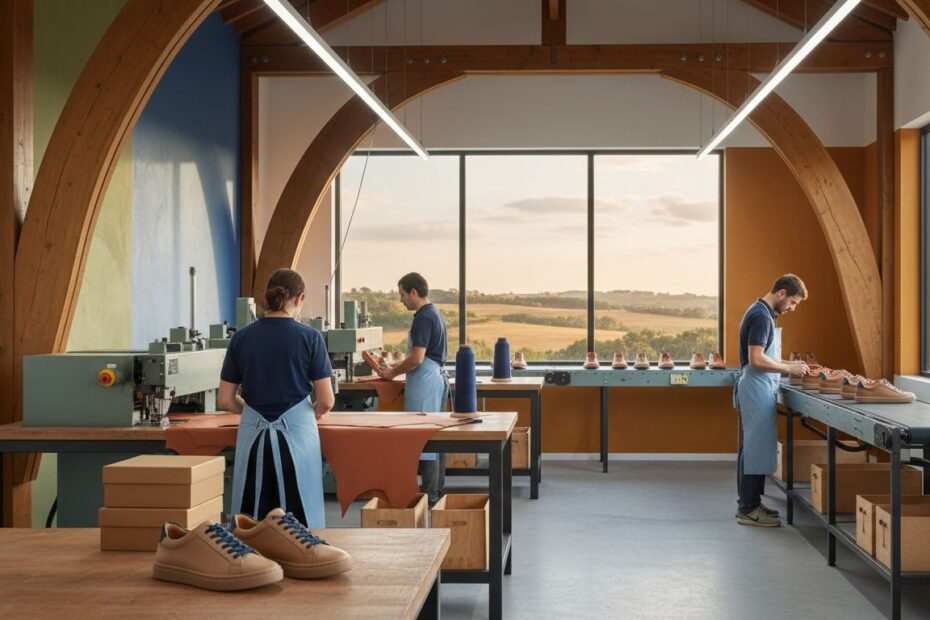
For footwear startups, the hardest part of launch is often not design or branding. It is finding a manufacturing setup that allows a new label to test the market without committing to volumes that strain cash flow, inventory, and working capital. This is one reason many emerging brands are turning to Portugal. The country’s footwear cluster increasingly serves as a nearshoring base for companies that want shorter lead times, lower minimums, and stronger product-development collaboration than they typically find in distant, high-volume sourcing models.
Portugal’s appeal goes beyond the label of European craftsmanship. Recent industry examples and studies point to a more practical advantage: flexible factories, localized supplier networks, and digital workflows that help brands move from concept to sample to small-batch production with more control. For entrepreneurs seeking a low MOQ shoe manufacturer in Portugal, the real opportunity is the ability to launch limited runs, refine product-market fit, and scale in stages.
Why Portugal Fits the Startup Footwear Model
Startups need manufacturing partners that understand uncertainty. A first collection may require only a limited run, a pilot launch, or a few colorways to validate demand. Portuguese footwear manufacturers and sourcing partners increasingly market exactly this kind of flexibility. Companies such as Shoes & More explicitly highlight “full flexibility for small and large-scale collections,” while Takeawalk promotes “flexible production volumes from small to large runs.” For a young brand, that means the factory model is aligned with testing rather than forcing premature scale.
This startup fit is reinforced by the evolution of the Portuguese footwear sector itself. A 2025 Cambridge University Press study describes the cluster as having shifted from a more traditional domestic-market structure to an innovative, export-focused industry. That matters because export-oriented factories tend to be better prepared for international brand requirements, technical documentation, quality standards, and the product-development cadence expected by modern B2B clients.
Recent sourcing reporting also suggests Portugal combines artisanal know-how with scalable industrial capacity. With roughly 80 million pairs produced annually and most output exported, the country offers a mature ecosystem rather than a niche workshop model alone. For startups, this creates an unusual balance: small-batch accessibility at the beginning, with capacity to grow later without rebuilding the supply chain from scratch.
How Flexible Factories Make Small-Batch Launches Viable
Small-batch footwear manufacturing works when factories can support development without making low-volume orders inefficient or operationally disruptive. Portugal’s flexible factories are increasingly set up for that reality. Instead of treating low quantities as exceptions, many manufacturers and sourcing agencies now present limited runs, sampling, and staged production as core services for emerging brands. This lowers the barrier to entry for founders launching capsule collections, pre-order campaigns, or direct-to-consumer test drops.
For startups, the main commercial advantage of flexible production is risk reduction. Rather than ordering large quantities across multiple sizes and styles, a brand can begin with a narrow assortment and gather market feedback. If sell-through is strong, the next run can expand. If fit, materials, or pricing need adjustment, the brand can iterate before excess inventory becomes a problem. This is especially useful in footwear, where sizing, comfort, and material performance often require real-world validation.
Flexibility also improves cash discipline. Early-stage brands rarely have the liquidity to fund large production commitments months in advance. By working with a low MOQ shoe manufacturer in Portugal, they can allocate capital more efficiently across design, branding, logistics, and customer acquisition. In practice, that makes the difference between a launch that is manageable and one that becomes overextended before the product even reaches the market.
Three Types of Footwear Organizations That Help Brands Start Small
The first type is the flexible factory itself: a manufacturer able to develop samples, adjust components, and produce low-to-medium quantities without sacrificing quality. This is the operational backbone of a small-batch launch. Startups benefit when the factory can support a first production run that is commercially realistic, while maintaining the technical consistency needed for later scaling.
The second type is the sourcing and production management partner. Portugal now has multiple agencies built around startup-friendly development support, and this layer is especially useful for non-technical founders. Shoes & More positions itself around flexibility for both small and large-scale collections, while LEKIP emphasizes footwear product development with a customized B2B approach and individually crafted solutions. For a new brand, that kind of guidance can simplify material selection, component sourcing, costing, and communication with the factory floor.
The third type is the broader domestic supplier network that surrounds the factory. Portuguese manufacturers are increasingly willing to work with wider networks of national suppliers in order to become faster and more flexible. This matters because small-batch success is not only about assembly capacity. It also depends on access to nearby material suppliers, component specialists, sample makers, and finishing partners who can support shorter development cycles and lower-volume experimentation.
Nearshoring Is Replacing Faraway, Slow-Moving Production
Many startups begin by exploring distant manufacturing regions because the unit economics appear attractive on paper. But once product changes, delays, freight variability, and communication friction are factored in, faraway sourcing can become difficult for a young brand to manage. Portugal is increasingly being used as a nearshoring base for brands that have outgrown that model. VEJA described Portugal as a “natural choice” when its Brazilian factories reached saturation, citing the country’s deep footwear know-how.
For startups, nearshoring is often less about geography alone and more about responsiveness. A factory that is closer to the target market and embedded in a dense footwear cluster can often move faster on samples, approvals, and replenishment. That is valuable for launch calendars tied to campaigns, trade shows, influencer seeding, or seasonal drops. It also helps founders maintain tighter control over quality and decision-making during the critical first production cycles.
The strategic benefit is that a startup can scale gradually while keeping manufacturing relatively close to market. This reduces the lag between learning and action. If customer feedback points to a need for better fit, different outsole behavior, or a refined upper material, a nearby and collaborative production base makes those changes easier to execute in the next run.
Localized Supply Chains Shorten Iteration Cycles
One of the strongest arguments for launching in Portugal is the ability to localize the supply chain. Hirundo’s founder noted that the brand ended up with shoes whose components were all made within 50 kilometers of the factory where final assembly took place. That level of proximity is highly relevant for startups because every handoff in product development affects speed, cost control, and problem-solving.
Localized sourcing reduces the time lost when a material needs replacement, a component fails testing, or a prototype requires immediate modification. Instead of waiting for long-distance approvals and shipments, brands can work within a compact manufacturing ecosystem. In practical terms, that can mean faster material confirmation, easier lab dips and component adjustments, and less friction when coordinating multiple suppliers around one launch timeline.
There is also a resilience advantage. A 2025 ScienceDirect study found that recent shocks pushed Portuguese manufacturers to shorten supply chains, improve logistics and digitization, and move toward faster, more flexible product development. The same research cites a sales manager explaining that companies built relationships with more national suppliers to become “faster and more flexible.” For startups, this translates into a supply base that is structurally better suited to rapid iteration than it was a decade ago.
Digital Workflows Are Making Small Brands Easier to Serve
Small brands used to face a coordination disadvantage when working with factories. They often lacked technical teams, on-site production managers, or the volume leverage needed to secure responsive service. Digital transformation is changing that. The 2025 Cambridge study examines digital channels and leadership capabilities in Portuguese footwear SMEs, showing how factories are adapting to more modern and efficient ways of working with clients.
For a startup, digital readiness can improve the full launch workflow. Tech packs, sample feedback, size grading notes, material approvals, and production updates can be handled more efficiently when a factory or sourcing partner is accustomed to structured digital communication. This does not replace craftsmanship, but it does reduce operational ambiguity, which is a major source of cost and delay in footwear development.
Digital tools also support a more iterative launch model. A brand can move from concept to sample, revise after testing, and organize a limited production run with better visibility over timelines and specifications. That is particularly important when the company is selling online, collecting pre-orders, or refining products based on early customer reviews. In this environment, Portugal’s modernized SMEs are becoming easier partners for smaller, fast-moving brands.
Sustainability Strengthens the Small-Batch Business Case
For many startups, small-batch production is not only a commercial strategy but also a sustainability decision. Producing closer to actual demand helps reduce overproduction and dead stock, both of which are recurring problems in fashion and footwear. Portugal’s manufacturing ecosystem increasingly supports this approach by combining low-volume development with more visible sustainability positioning.
Portuguese brands and factories are actively building that narrative. A 2024 Portuguese Shoes/Portugal Global piece reported that some companies aim for a growing share of sustainable collections, highlighting sustainability as a market advantage. New.ve is an example of a Portugal-designed and Portugal-produced footwear brand using circular-economy principles and unconventional materials, showing how local production can reinforce a differentiated product story.
The ecosystem is also broadening beyond standard shoe manufacturing alone. Portugal Ventures’ 2025 booklet highlights footwear recycling and industrial innovation, suggesting a wider landscape of circular manufacturing capabilities. For startups, this opens opportunities to develop products that are not only low MOQ and well-made, but also aligned with eco-conscious positioning from the beginning of the brand journey.
Innovation in Portugal Goes Beyond Materials
When founders evaluate Portugal, they often first think about leather expertise, stitching quality, or traditional craftsmanship. Those remain important strengths, but innovation in the country’s footwear sector now extends into product development itself. Ambitious’ Venture sneaker, launched in 2024 and developed with an international partner, was presented as a Portuguese-made innovation project, illustrating that factories and brands are participating in more advanced development models.
This is relevant for startups because product innovation does not always mean inventing a new material. It can also mean integrating better construction methods, refining comfort engineering, testing new outsole concepts, or improving the manufacturability of a custom design. A factory ecosystem that is already engaged in this kind of development can add value well beyond simple order fulfillment.
For private-label and custom projects, that capability is especially attractive. Entrepreneurs do not just need production space; they need feedback on what can be built reliably, what will perform in wear, and how to align design ambition with commercial practicality. Portugal’s mix of development expertise and flexible production makes that conversation easier to have at an early stage.
For startups launching footwear today, Portugal offers more than a prestigious country of origin. It offers a practical operating model: low-volume capability, nearshoring advantages, localized supplier networks, digital collaboration, and growing sustainability alignment. These features make it possible to launch with less inventory risk, shorter iteration cycles, and stronger control over quality and brand positioning.
The clearest lesson is that flexible factories work best when supported by the right ecosystem. In Portugal, brands can start small through three key footwear organizations: flexible factories, sourcing and development partners, and responsive domestic supplier networks. Together, they give emerging labels a realistic path from concept to market, making Portugal one of the strongest options for any entrepreneur seeking a low MOQ shoe manufacturer in Portugal.